How to Dress for Your Body Type (A Proportion-First Guide That Actually Makes Sense)
Table of Contents
Knowing how to dress for your body type is often presented as a list of rules.
Wear this.
Avoid that.
Balance here.
Hide there.
But that approach misses the real issue.
Most outfits don’t feel “off” because of your body. They feel off because of proportion.
When you understand how clothing interacts with your frame, where visual weight sits, where the eye stops, where structure begins; getting dressed becomes easier. Shopping becomes more intentional. And you stop blaming yourself for garments that were never designed for your proportions in the first place.
This guide is not about correcting your body.
It’s not about shrinking, hiding, or chasing an ideal.
It’s about learning to see proportion.
Because once you can see it, you can control it.
If you’re new to thinking about your closet as a system, start with The 3-3-3 Rule: A Wardrobe Formula That Brings Structure to Your Closet.
Body Type Is About Proportion, Not Correction
“Dress for your body type” has been distorted into something restrictive.
In reality, stylists don’t look at bodies and assign rules. They observe distribution; how visual weight is carried across the shoulders, waist, and hips. They notice where fabric pulls, where volume stacks, and where the silhouette breaks.
I’ve watched this play out in real time.
Two women can wear the same blazer. One looks sharp. The other looks slightly off. The difference isn’t body size. It’s where the fabric lands and how the structure supports the frame underneath.
Body type is simply a way to describe how your proportions are distributed.
When an outfit feels awkward, the issue is rarely size. It’s usually:
Too much volume in one zone
A hem landing at the widest point of the calf
No visible waist definition
Competing shapes
Fabric that fights your natural lines
If you’ve ever stood in front of the mirror thinking, “Why does this look weird on me?” — this is usually why.
Understanding body proportions removes shame from getting dressed. It replaces guesswork with clarity.
You’ll see this in action in How to Style Jeans: 10 Chic Ways That Go Beyond Blue, especially when hem length shifts the silhouette.
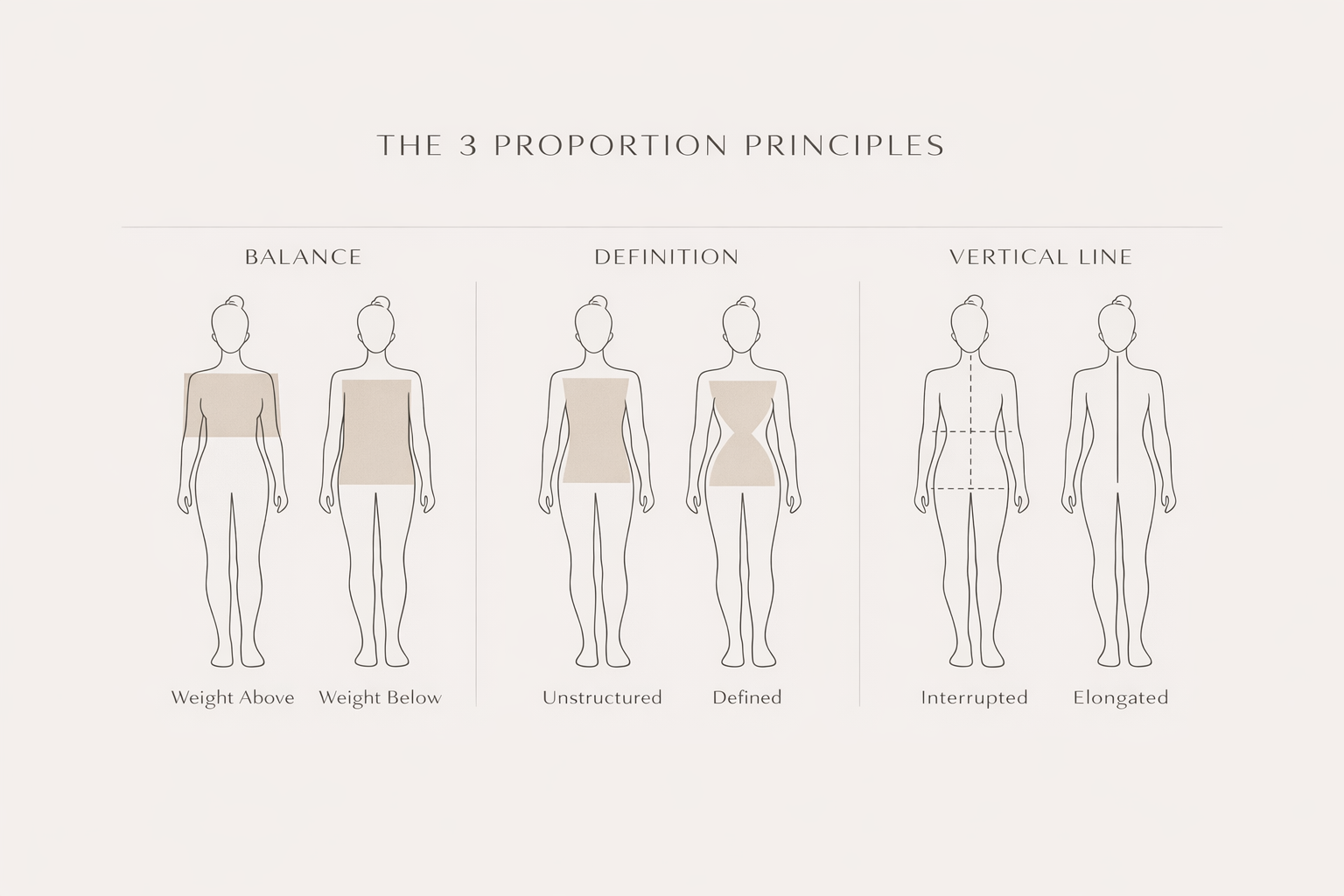
The 3 Proportion Principles Stylists Use
Before body type even enters the conversation, stylists look at three things.
1. Balance (Visual Weight Distribution)
Where does visual weight sit: top, middle, or bottom?
Chunky shoes, wide-leg trousers, heavy knits, and long layers all add weight. If everything stacks in one area, the silhouette compresses.
I’ve seen someone blame the pants when it was actually the oversized sweater and heavy boot creating the imbalance.
Balance doesn’t mean symmetry. It means intentional distribution.
If volume exists on the bottom, structure or clarity often helps on top.
If emphasis sits at the shoulders, grounding below can stabilize the look.
2. Definition (Where Structure Lives)
Definition creates clarity.
This can show up as:
A defined waist
Structured shoulders
A crisp hem
A clean neckline
Without some form of definition, your body shape can blur.
You know that feeling when an outfit technically “fits” but still looks unfinished? That’s usually a lack of structure.
Structure gives your shape a visual anchor.
And structure does not mean tight.
It means intentional. So intentional that you won’t need accessories to finish the look.
3. Vertical Line (How the Eye Travels)
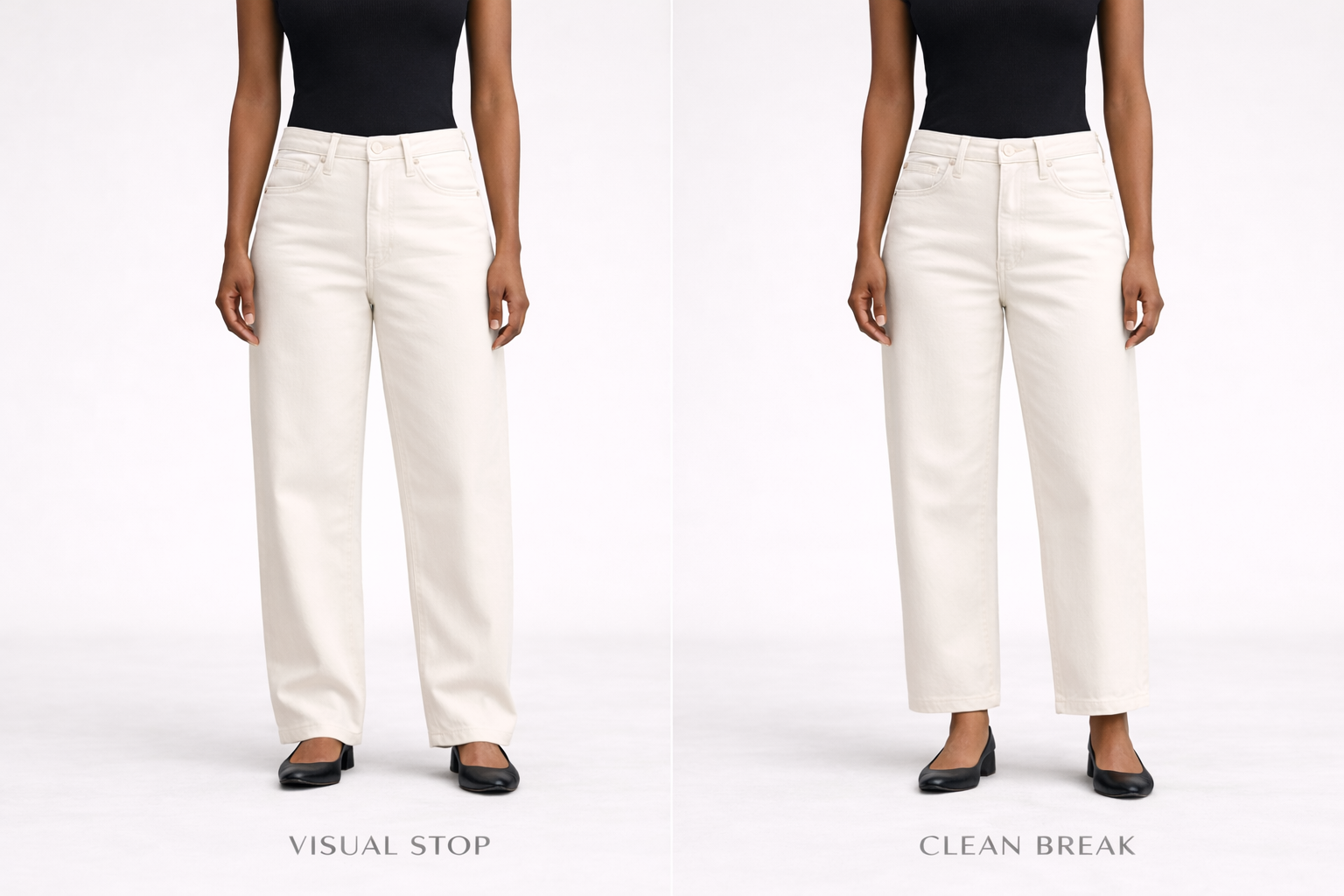
The eye moves in lines.
Where does it stop?
A hem that cuts at the widest part of the calf shortens the leg visually.
A jacket that ends at the widest part of the hip adds width.
A long open layer creates vertical movement.
If you’ve ever felt like you look shorter in one outfit than another, check where your layers are ending.
Understanding vertical line changes everything about how outfits read.
Once you understand these three principles, dressing for your body type becomes much simpler.
A Real Life Proportion Shift (Before You Change Your Body, Change the Lines)
You don’t need a new body.
You need a new line.
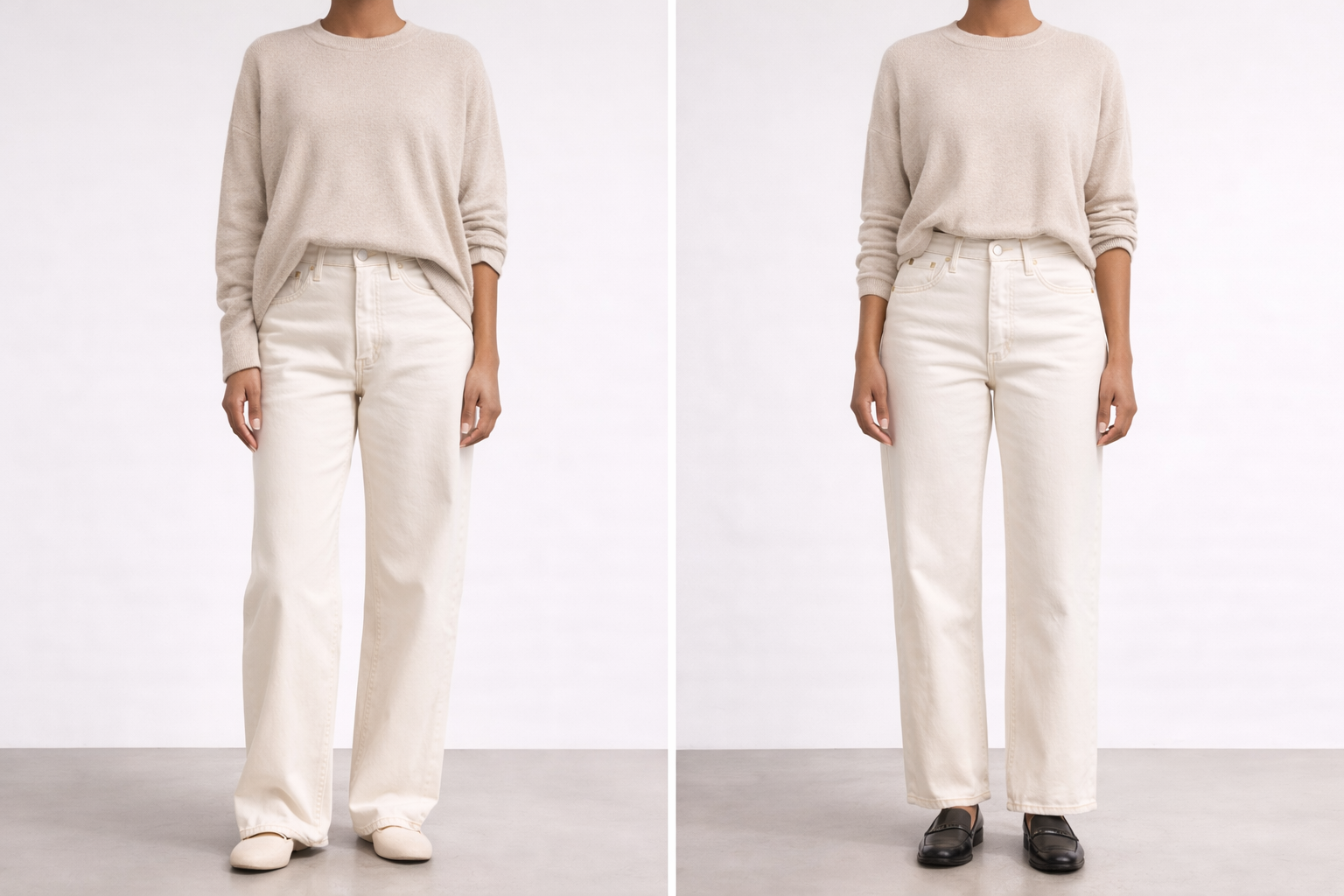
Imagine two versions of the same outfit.
Version one:
Oversized knit.
Mid-rise straight jeans.
Hem stacking at the ankle.
Flat shoe with no structure.
Nothing is technically wrong.
But the volume stacks at the bottom.
There’s no waist clarity.
The eye stops at the ankle.
Version two:
Same knit — lightly tucked.
Same jeans — hem shortened slightly.
Same shoe — but structured.
The difference isn’t weight.
It’s line.
This is what proportion does. It shifts how the eye moves.
Once you understand that, you stop trying to shrink yourself and start refining the silhouette.
The 5 Body Types Explained Through Proportion
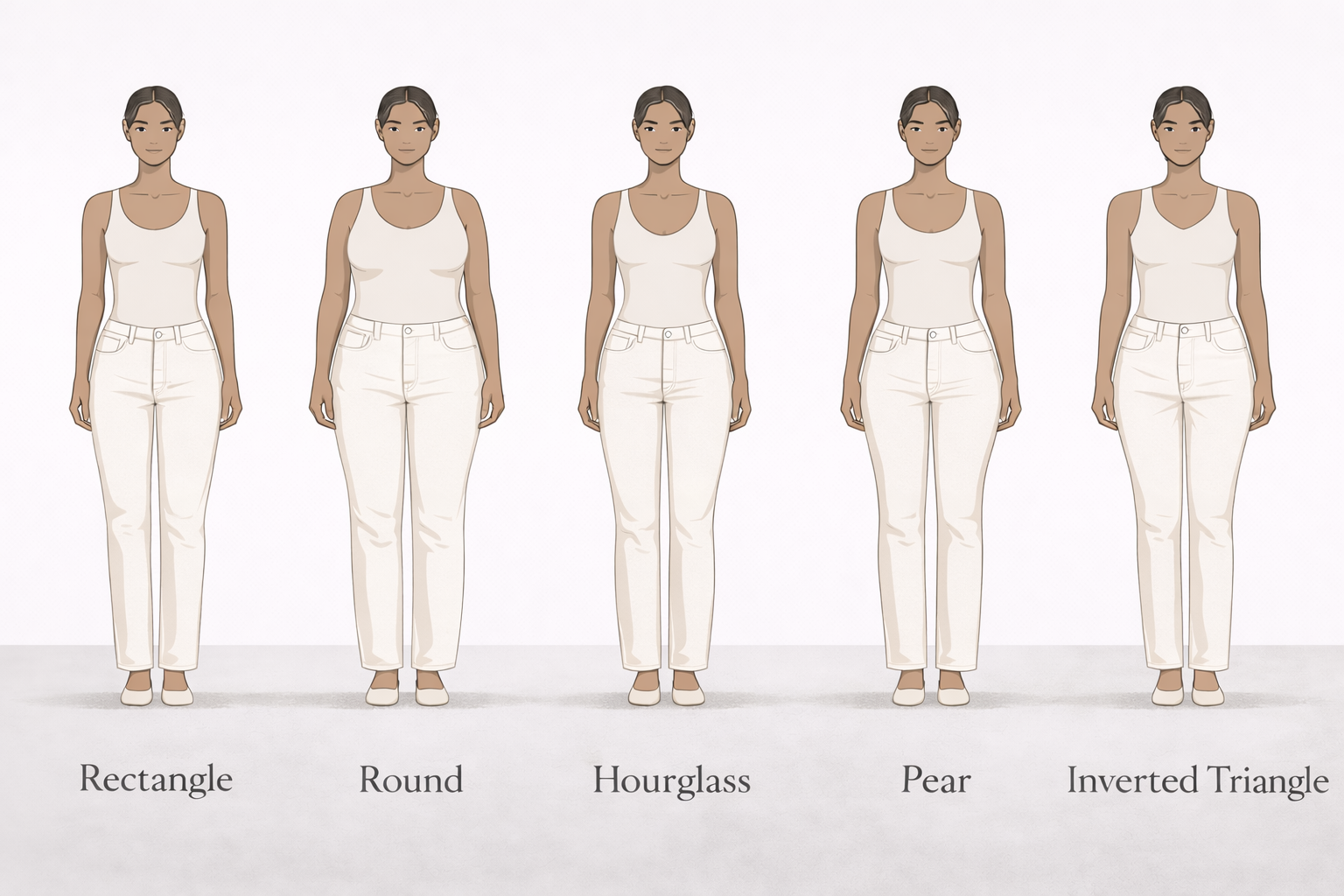
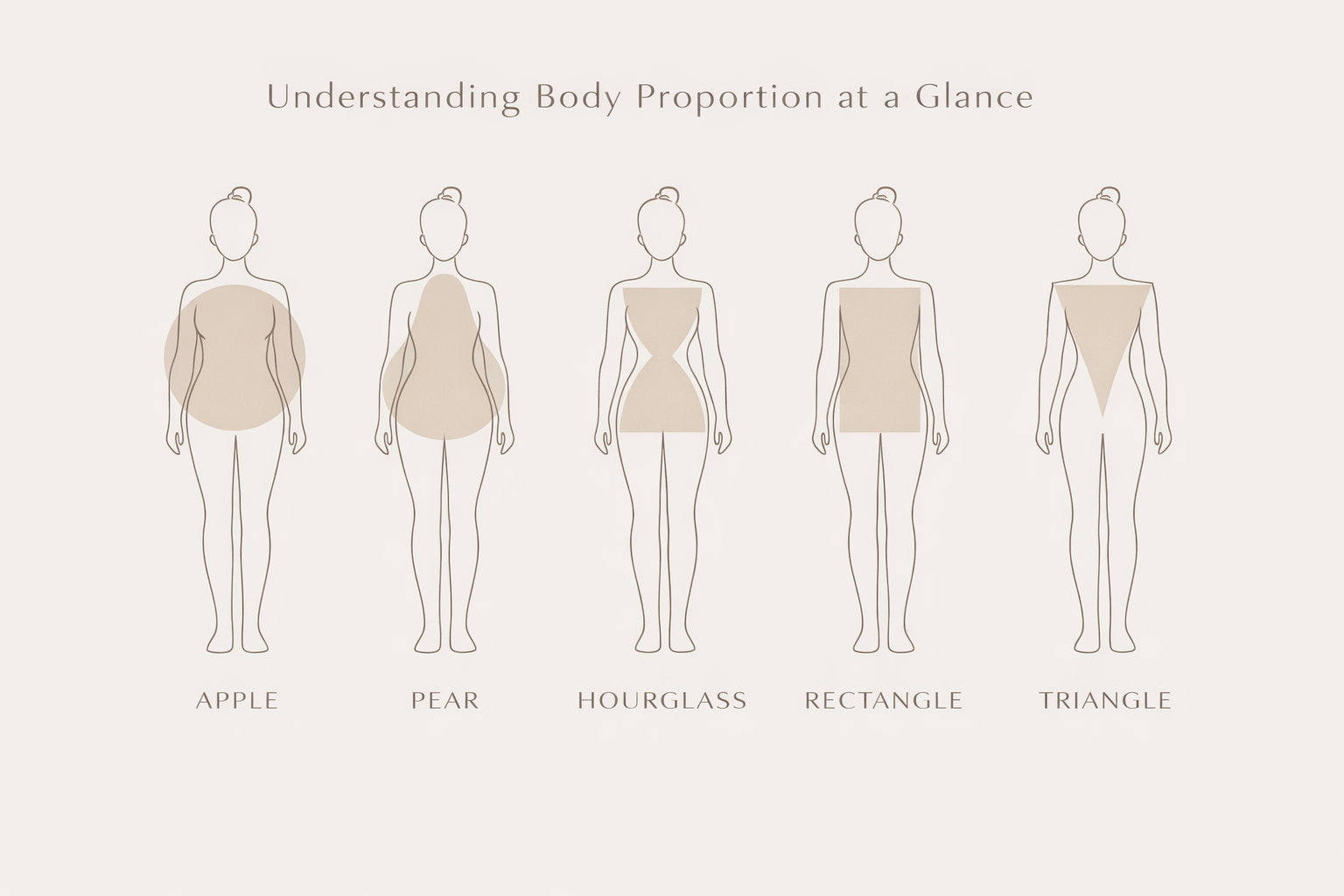
These categories describe distribution of visual weight, not value.
You may fall clearly into one.
You may sit between two.
That’s normal.
Rectangle (Straight) Body Type
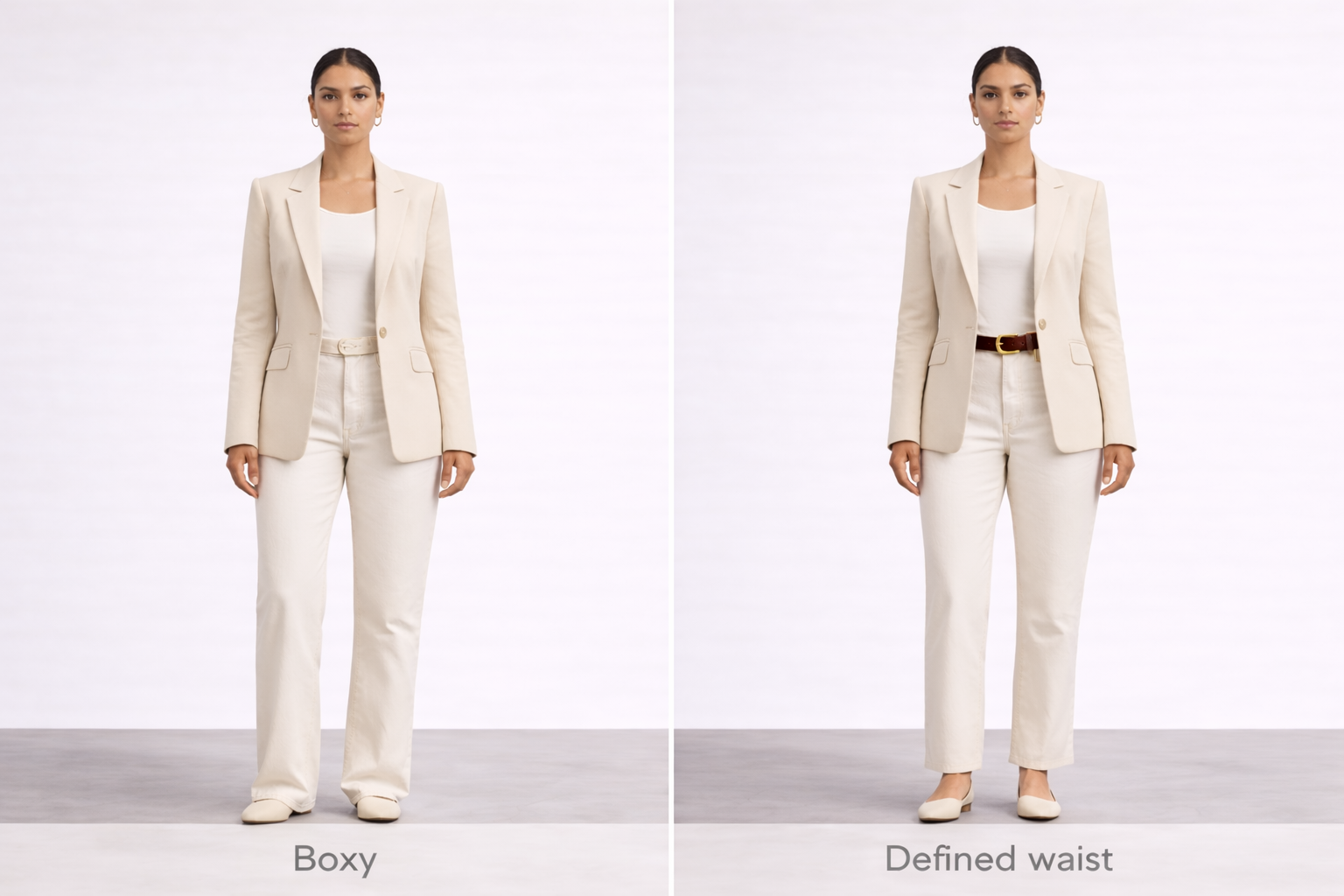
If your shoulders and hips are similar in width with minimal natural waist definition, you likely have a rectangle body shape.
Goal:
Create definition where there isn’t much natural indentation.
For straight body types, a belt works because the torso is relatively even from shoulder to hip.
There isn’t concentrated visual weight at the midsection, so adding a belt introduces contour rather than emphasis.
It creates dimension without adding volume.
How to dress a rectangle body shape
Proportion shifts:
Add waist emphasis through belts or tailored seams
Introduce layering or texture for depth
Avoid overly boxy silhouettes that remove all shape
Outfit formula:
Structured jacket + straight-leg jean + defined waist detail
For real outfit examples built around this structure, explore 10 Jeans Outfits That Prove Blue Was Never the Limit.
Round (Apple) Body Type
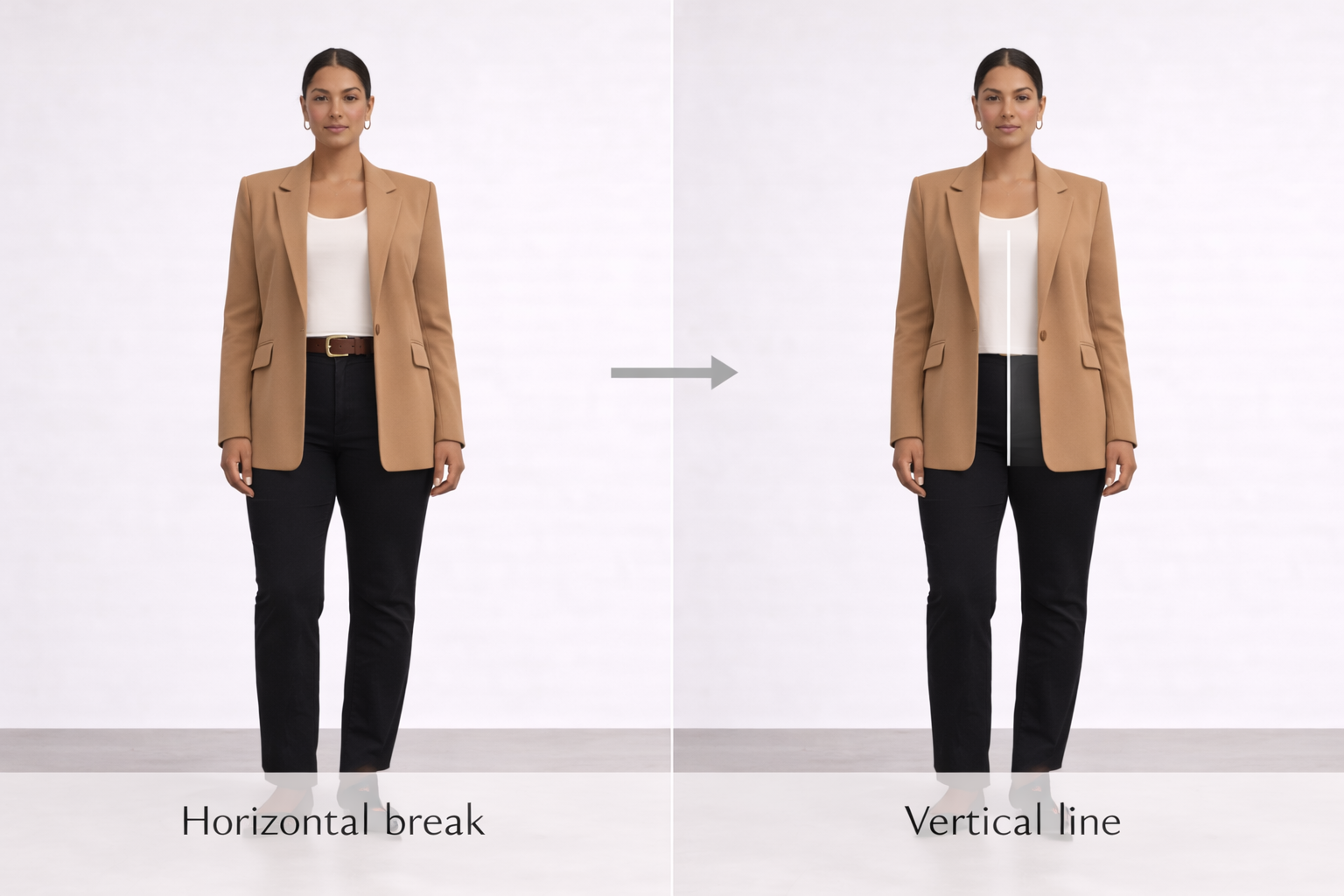
If you carry more visual weight through the midsection with slimmer legs, you likely have an apple body shape.
Goal:
Avoid drawing a horizontal line across the fullest part of the torso.
For apple body types, balance comes from vertical control, not tight waist emphasis.
A belt can work, but only if:
It sits slightly above or below the fullest point
It’s subtle
The garment underneath skims rather than clings
A tight belt at the widest part creates interruption, not definition.
How to dress an apple body shape
Proportion shifts:
Create vertical lines with open layers
Choose structured fabrics that skim
Avoid heavy visual breaks at the midsection
Outfit formula:
Longline blazer + slim pant + clean neckline
Hourglass Body Type
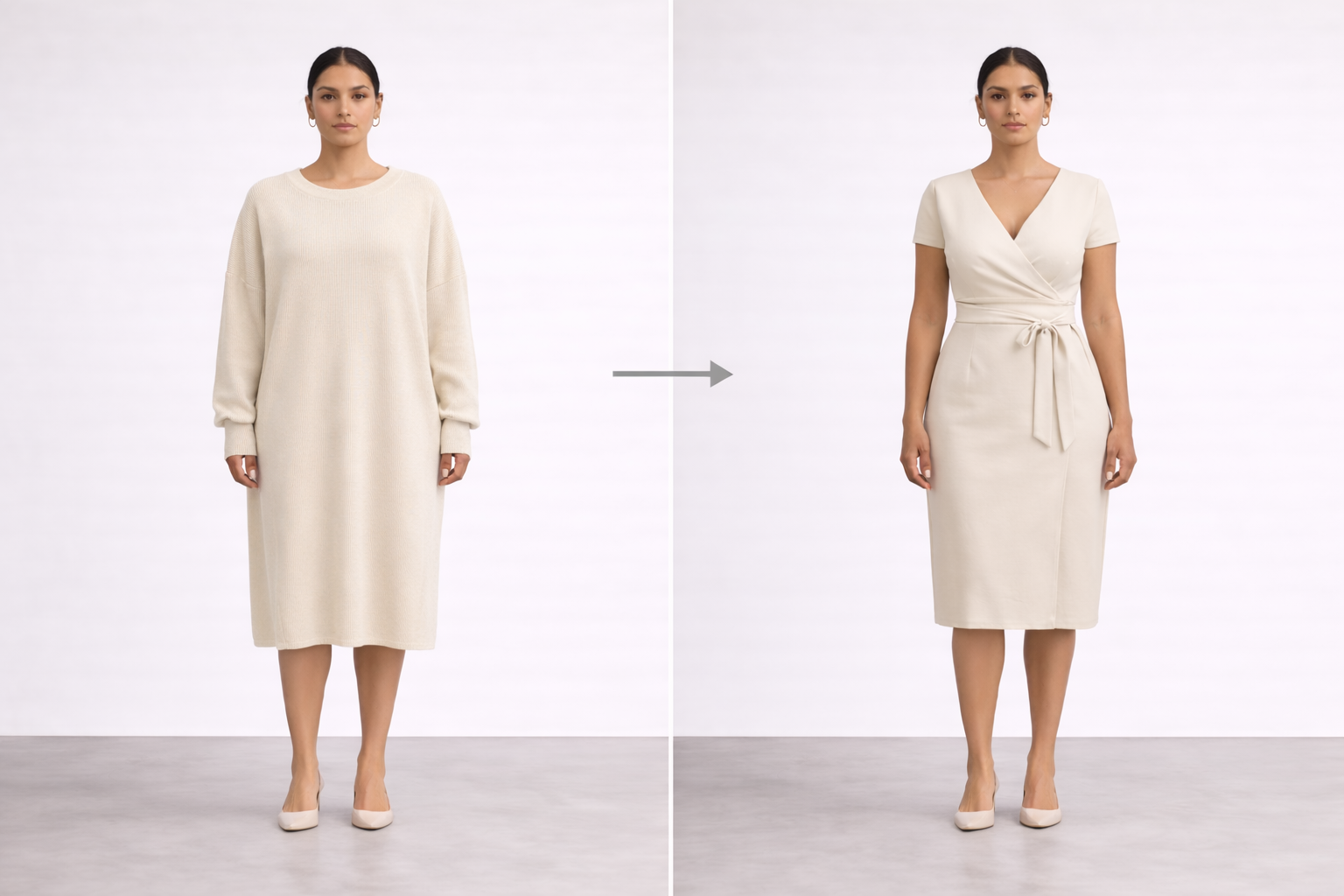
If your shoulders and hips are balanced with a clearly defined waist, you likely have an hourglass body shape.
Goal:
Preserve natural symmetry and waist definition.
On the left, excess volume hides the waist and flattens the silhouette.
On the right, the wrap dress follows the natural waist, maintaining balance between shoulders and hips.
For hourglass figures, the key isn’t adding shape, it’s not erasing it.
How to dress an hourglass body
Proportion shifts:
Follow the natural waist instead of disguising it
Avoid excess volume that distorts symmetry
Maintain balance between top and bottom volume
Outfit formula:
Wrap dress or fitted knit + structured bottom.
Pear (Triangle) Body Type
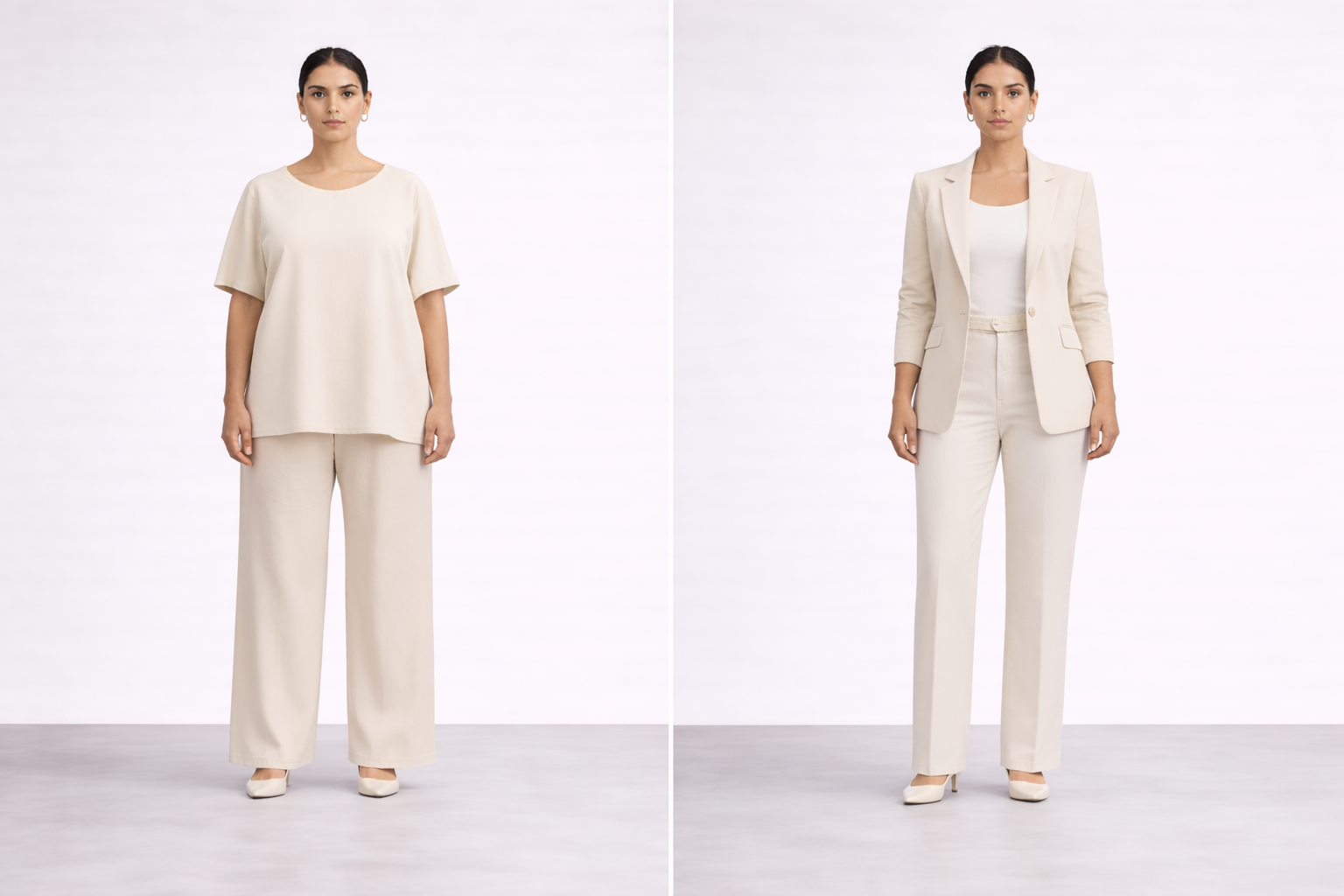
If your hips are wider than your shoulders, you likely fall into the pear body type.
Common frustration:
Your lower half can feel visually dominant, even when your waist is defined.
How to dress a pear shape
Balance comes from shifting attention upward.
Proportion shifts:
Add structure or detail to the upper body (structured jackets, defined shoulders, texture)
Keep bottoms streamlined rather than bulky
Avoid excess volume at the hip
Outfit formula:
Structured top + clean straight-leg or A-line bottom.
Inverted Triangle Body Type
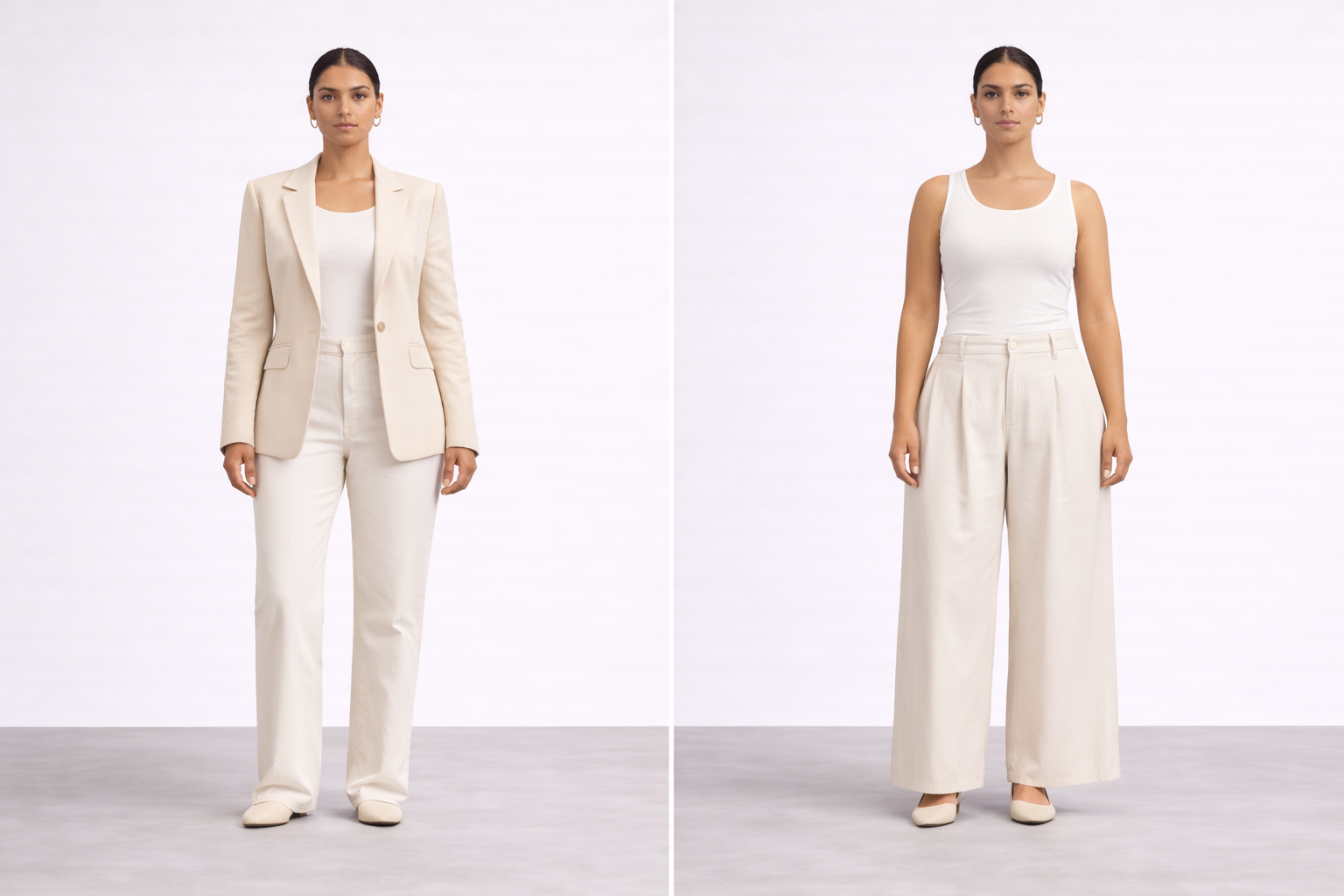
If your shoulders or bust are wider than your hips, you likely have an inverted triangle body shape.
Goal:
Shift visual weight downward.
If your shoulders carry more width than your hips, balance comes from below, not from shrinking the top.
Keep the upper half clean.
Add presence through a wide-leg trouser or A-line shape.
Balance isn’t reduction.
It’s redistribution.
Proportion shifts for inverted triangle shapes
Add volume below the waist
Keep the upper body minimal
Avoid exaggerated shoulder structure
Outfit formula:
Soft knit + wide-leg trouser or A-line skirt
How to Identify Your Body Type (Without Obsessing)
You can use measurements:
Shoulders
Bust
Waist
Hips
Compare distribution rather than numbers alone.
But there’s an easier way.
Look at how clothes behave.
Do jeans pull at the hip but gap at the waist?
Do blazers strain across the shoulders?
Does fabric gather at the midsection?
Do straight cuts feel shapeless?
Clothing behavior often reveals how your proportions interact with garments more clearly than math ever will.
The 5-Minute Proportion Audit
Stand in front of a mirror and ask:
Where does my eye stop?
Is there a clear waist?
Is volume stacking in one zone?
Is my hem landing at the widest point of my calf?
Does fabric skim or fight my shape?
You don’t need to fix anything.
You need to notice patterns.
Patterns reveal proportion.
Universal Principles That Apply to Every Body Type
Fit Over Size
Most people focus on the number on the tag.
Stylists focus on how the garment actually sits on the body.
Two sizes can look completely different depending on brand, fabric, and cut. If something pulls across your shoulders, gaps at the waist, or requires constant adjusting, that’s not a reflection of your body, it’s a fit issue.
Clothing should skim your shape without straining or collapsing.
The goal isn’t a smaller number.
It’s a smoother silhouette.
Fabric Weight Changes Everything
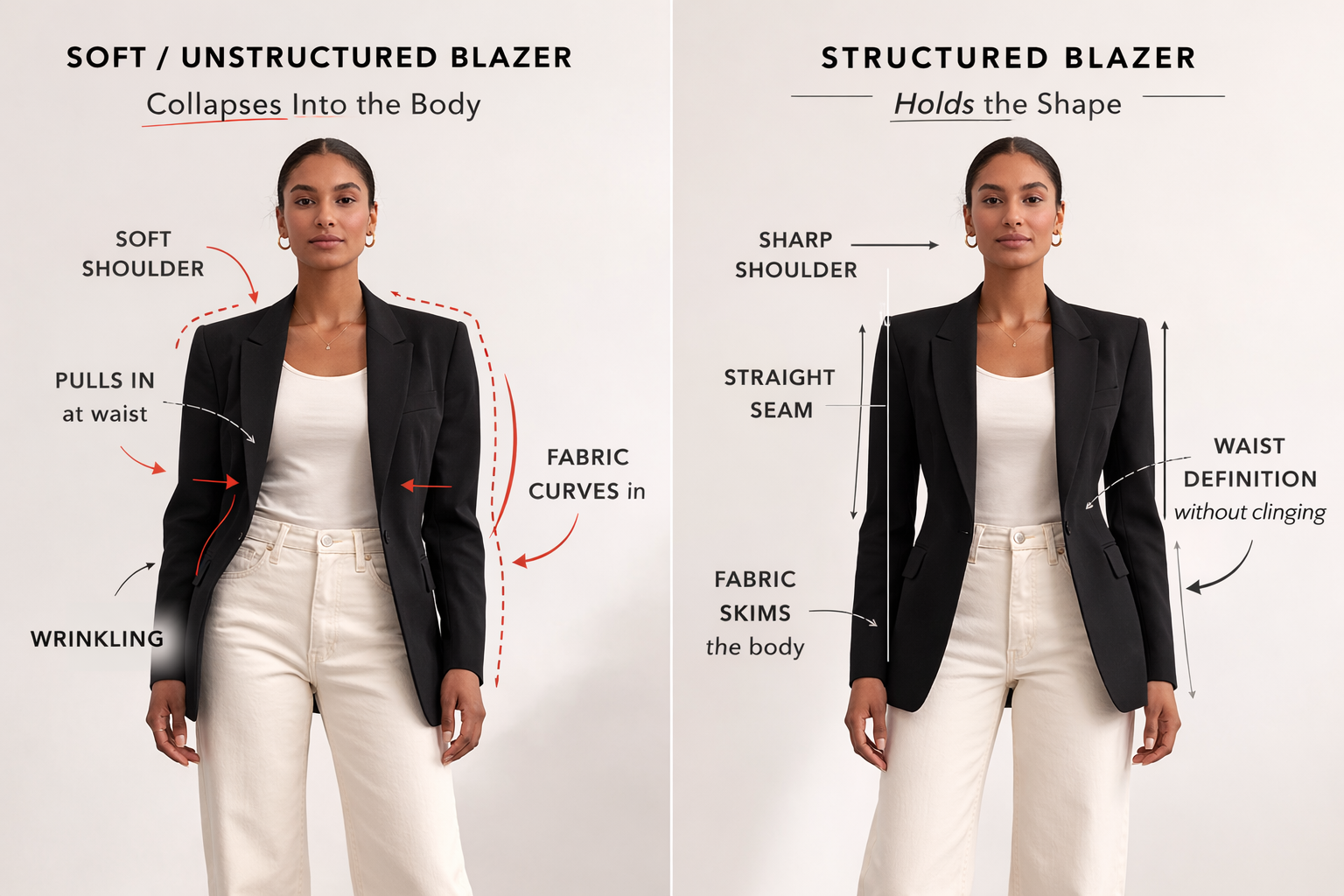
Not all fabrics behave the same, even when the cut is identical.
I once owned two blazers. One thin and slouchy. One structured and cheaper, but it held its shape.
The structured one was the one that got compliments. Not because of the label. Because of the lines it created.
A blazer made from thin material collapses into the body. The same blazer in structured cotton or wool holds its shape and creates definition.
If an outfit feels messy or undefined, it’s often not the design, it’s the fabric.
Ask yourself:
Does this material hold its shape?
Or does it collapse into mine?
That question changes how you shop.
I go deeper into this in How to Style Ballet Flats: 7 Modern Outfit Formulas That Feel Elevated, where fabric weight completely shifts how a flat reads.
Tailoring Is Underrated (And Often the Missing Link)
Tailoring is one of the most overlooked tools in proportion.
Most people assume if something “mostly fits,” it’s good enough. But “almost right” is often what makes an outfit feel slightly off.
Small refinements completely change how a garment reads on your body.
A hem that puddles at the ankle can make the leg look shorter and heavier. Shorten it just enough to create a clean break above the shoe, and the entire silhouette feels sharper.
A blazer sleeve that extends past the wrist can swallow the hand. Adjust it so the wrist bone shows, and the upper body instantly looks more intentional.
A waistband that gaps disrupts the line of the outfit. Taking it in restores structure and balance.
None of these changes alter your body.
They refine the lines around it.
You don’t need full reconstruction.
You need precision.
Often, the difference between “this works” and “this looks polished” is an inch in the right place.
Tailoring doesn’t change your proportions.
It clarifies them.
Footwear Anchors the Entire Silhouette
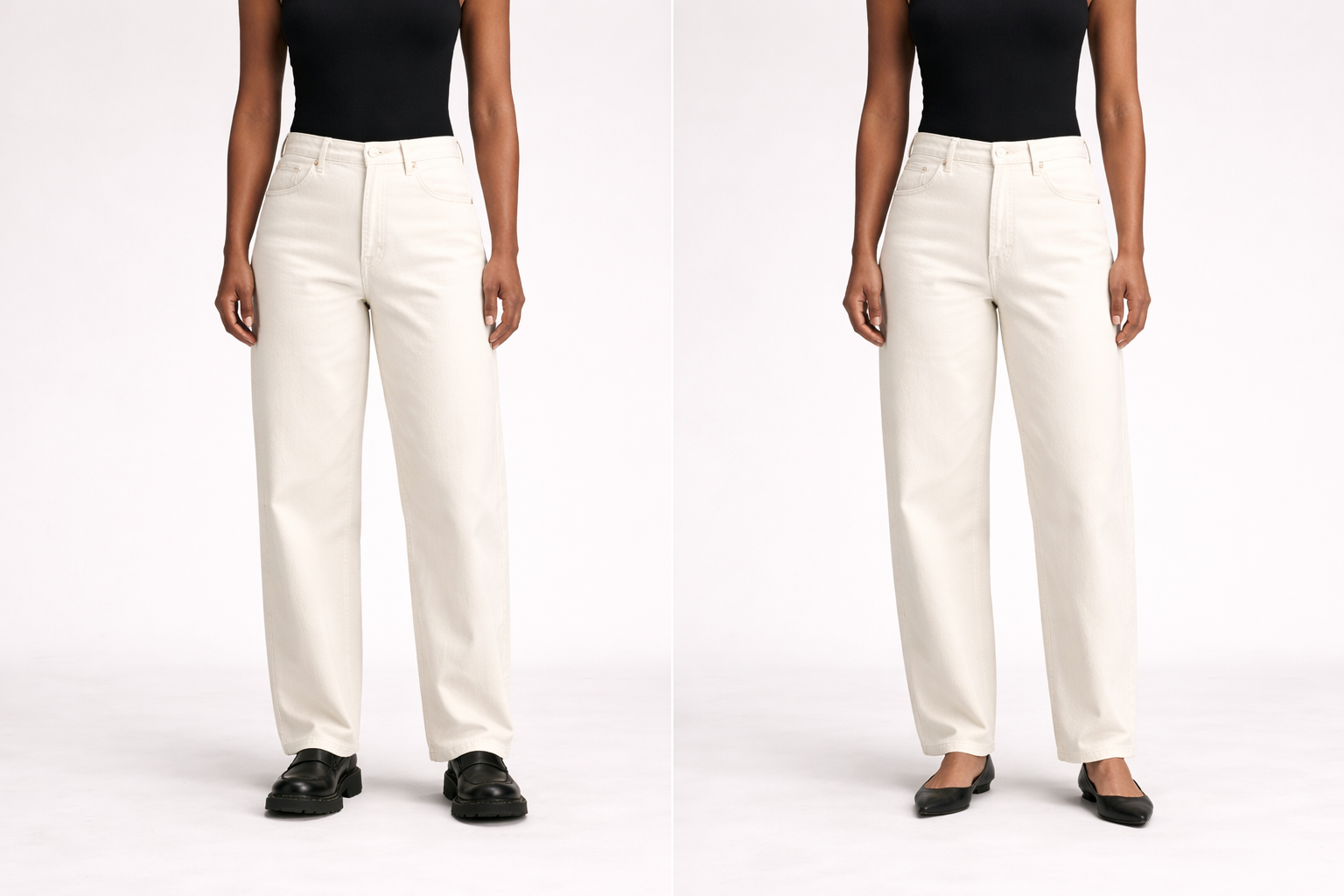
Shoes don’t just finish an outfit, they anchor it.
Every shoe carries visual weight.
Chunky loafers, lug soles, thick sneakers, and heavy boots pull the eye downward and add density to the lower half. That can feel grounded and strong, or bottom-heavy if there’s no structure above to balance it.
Slim flats, pointed toes, and sleek heels do the opposite. They lighten the base and elongate the leg line.
This is why the same jeans and sweater can feel polished with a structured loafer, and slightly sloppy with an overly soft sneaker.
If you’ve ever tried on an outfit and thought,
“Why does this suddenly look heavy?”
Look at your shoes first.
Footwear influences proportion, perceived height, and how visual weight is distributed from top to bottom.
Before adjusting your body or abandoning the outfit, consider what’s anchoring it.
Often, the shoe is doing more than you think.
If you want to see how different shoes anchor the same outfit, read How to Wear Loafers: 8 Modern Outfits for 2026.
How to Reset Your Wardrobe Using Proportion (Without Starting Over)
Before buying anything new, do this:
Pull out three outfits you always feel good in.
What do they have in common? Waist clarity? Clean hems? Structure?Pull out three outfits you never reach for.
Where does the line break? Where does volume stack?Adjust one variable.
Hem. Tuck. Layer. Shoe.
Often the problem isn’t the item. It’s the proportion.
Clarity saves money.
Confusion wastes it.
Putting Proportion Into Practice
Dressing for your body type isn’t about chasing balance for the sake of it.
It’s about understanding how shape, line, and fabric interact with your proportions.
Once you see that, you stop asking,
“What’s wrong with my body?”
And start asking,
“What is this garment doing to my silhouette?”
That question changes everything.
And that’s where real style begins.
Frequently Asked Questions
Can your body type change?
Yes. Distribution shifts over time due to age, hormones, or lifestyle. Reassess proportion when clothing behavior changes.
Can you be more than one body type?
Absolutely. Use the category that best explains how clothes behave on you.
Does height affect body type?
Height affects vertical proportion, not horizontal distribution. Both matter.
Do I have to follow these guidelines?
No. Proportion is a tool, not a rulebook.
